Michael Logan

Novelist, Journalist and other things ending in -ist

  • Novels
    • Hell’s Detective
    • World War Moo
    • Wannabes
    • Apocalypse Cow
  • Short Stories
    • We Will Go On Ahead and Wait for You
    • Shade
    • The Red Lion
    • When the Dead Walked the Earth – Without Kevin
    • More stories
  • About
  • Newsletter
  • Contact
  • Blog

Hell’s Detective: Lost Angeles sample to celebrate new website launch

September 23, 2015 by Michael Logan

Evil MichaelAs you may have noticed from the proliferation of shiny around you, I have finally built a new website for all things bookish.

To mark this momentous occasion, which I believe may have momentarily stopped the globe from rotating (this may be why you felt several pounds lighter for 0.2 milliseconds at 3pm yesterday), I’ll be featuring lots of content in the coming weeks and months: largely short stories and novel extracts.

Kicking us off we have the first three chapters from my next novel, Hell’s Detective: Lost Angeles, a noir set in Hell. Hell’s Detective is a slight departure from previous works, in that it isn’t an out-and-out comedy. You will, however, find a light sprinkling of jokes therein.

As I don’t have a cover yet, this post is accompanied by an artist’s impression of what I might look like if I were a denizen of Hell. The artist should probably learn to draw better, but he really can’t be bothered.

I can’t tell you when this novel is going to be released. It’s still limping around the rain-drenched streets, tapping on the brightly lit windows of agents and publishers, smiling wanly and hoping they invite it in for champagne and caviar, rather than drawing the curtains and sending out the servants to beat it bloody with a dirty broom.


UPDATE, 0310/2015: Link to novel sample and blurb removed (it was only ever going to be up temporarily).

Enjoy!

[feather_share]

Filed Under: fiction, horror Tagged With: fiction, hell's detective, horror, noir

Wannabes is now on sale

July 21, 2014 by Michael Logan

My second novel, Wannabes, is now available to buy as an ebook. To celebrate, I’m giving away twenty copies. In order to enter the random draw, please spread the news on your blog, Twitter or Facebook and send me an email at freelancelogan@fastmail.co.ukto let me know you have done so. I’ll draw the winners on July 28 and send a code for the free download.
The book (and sample chapters) is currently available on Amazon UK and US, as well as all the other country stores, and through iBooks. It is also available in all ebook formats through Smashwords. The price is $3 or the currency equivalent. You can get it for the Nook from Barnes and Noble and will soon be on sale through Kobo and other ebook stores.
If you are on Goodreads, you can add the book here.
Also, don’t forget that the release date for Apocalypse Cow: World War Moo has been set as 9 June 2015. Put it in your calendar!

Wannabes
Celebrities are mobbing London’s laser clinics as a deranged wannabe bumps off A-listers, believing he can absorb their powers and become famous by taping their tattoos to his body.
Washed-up pop star Jackie Thunder isn’t joining the stampede. Jackie figures that if he can get on the killer’s hit list, without the inconvenience of being murdered, he’ll gain the publicity needed to reignite his career.
But there’s more at stake than Jackie can possibly imagine. His desperate ploy for attention plunges him into the heart of a decades-old demonic plot to destroy great music through murder, mayhem and manipulation.
With humanity’s collective soul at stake, how far will Jackie go to reach the top?

Filed Under: angels, apocalypse cow, culture, demons, fantasy, fiction, horror, michael logan, novel, satire, society, tattoos, Wannabes, World War Moo

Two books on the way

June 20, 2014 by Michael Logan

As you may know by now, the sequel to Apocalypse Cow is on its way. Entitled Apocalypse Cow: World War Moo, it will be released by St. Martin’s Press in mid-2015. Full details will emerge in good time.

However, I can reveal that Geldof and Lesley will be back – along with some new characters – as we embark on an adventure involving combat yoga, ferocious Noel Edmonds lookalikes, and cow bombs in an infected Britain about to be obliterated by an all-out international offensive.

To fill the gap in the meantime (it has been over two years since Apocalypse Cow first came out), I will be releasing an eBook in the next few months. You can read the blurb and first three chapters of this book, Wannabes, below.

The cover, final release date, and links to buy will be unveiled over the next few weeks. If any book bloggers want a review copy, drop me a line through the contacts page on my website, and I’ll send you a DRM-free eBook once the final edits and design elements are completed (likely mid-July).

Wannabes

I want my children to listen to people who fucking rocked. I don’t care if they died in puddles of their own vomit. I want someone who plays from his fucking heart – Bill Hicks

Celebrities are mobbing London’s laser clinics as a deranged wannabe bumps off A-listers, believing he can absorb their powers and become famous by taping their tattoos to his body.

Washed-up pop star Jackie Thunder isn’t joining the stampede. Jackie figures that if he can get on the killer’s hit list, without going so far as being murdered, of course, he’ll gain the publicity needed to reignite his career.

But there’s more at stake than Jackie can possibly imagine. His desperate ploy for attention plunges him into the heart of a decades-old demonic plot to destroy great music through murder, mayhem and manipulation.

With humanity’s collective soul at stake, just how far will Jackie go to reach the top?


Read the first three chapters here.

Sign up to the mailing list to be sure you don’t miss any news on releases.

Filed Under: apocalypse cow, fiction, michael logan, novel, sequel, Wannabes, World War Moo

Back in a flash

May 20, 2014 by Michael Logan

It’s been a while since I’ve written flash fiction. 250 words doesn’t leave much wiggle room to tell a story, but it’s a lot of fun to be back as I get something ready for the Bridport Prize. 
My last flash won the Fish Publishing Flash Fiction Prize, so at least I have some previous form in the form and may be in with an outside shout. You never know with these prizes, as you have to get through two layers of reader before the final judge even sees your work, so you are dealing with three different sets of literary taste buds.
What I am remembering is that every word is crucial. With the last story, I spent weeks scrutinizing, swapping and fiddling, down to the point where I changed one word about ten times. My planned Bridport entry is now fully written and within the word count, but I am definitely getting out the fine-mesh strainer to refine it over the course of this week.
Anyway, you can read my previous winner here if you have two minutes to spare to see just how tight you have to be.

Filed Under: bridport, fiction, fish, flash

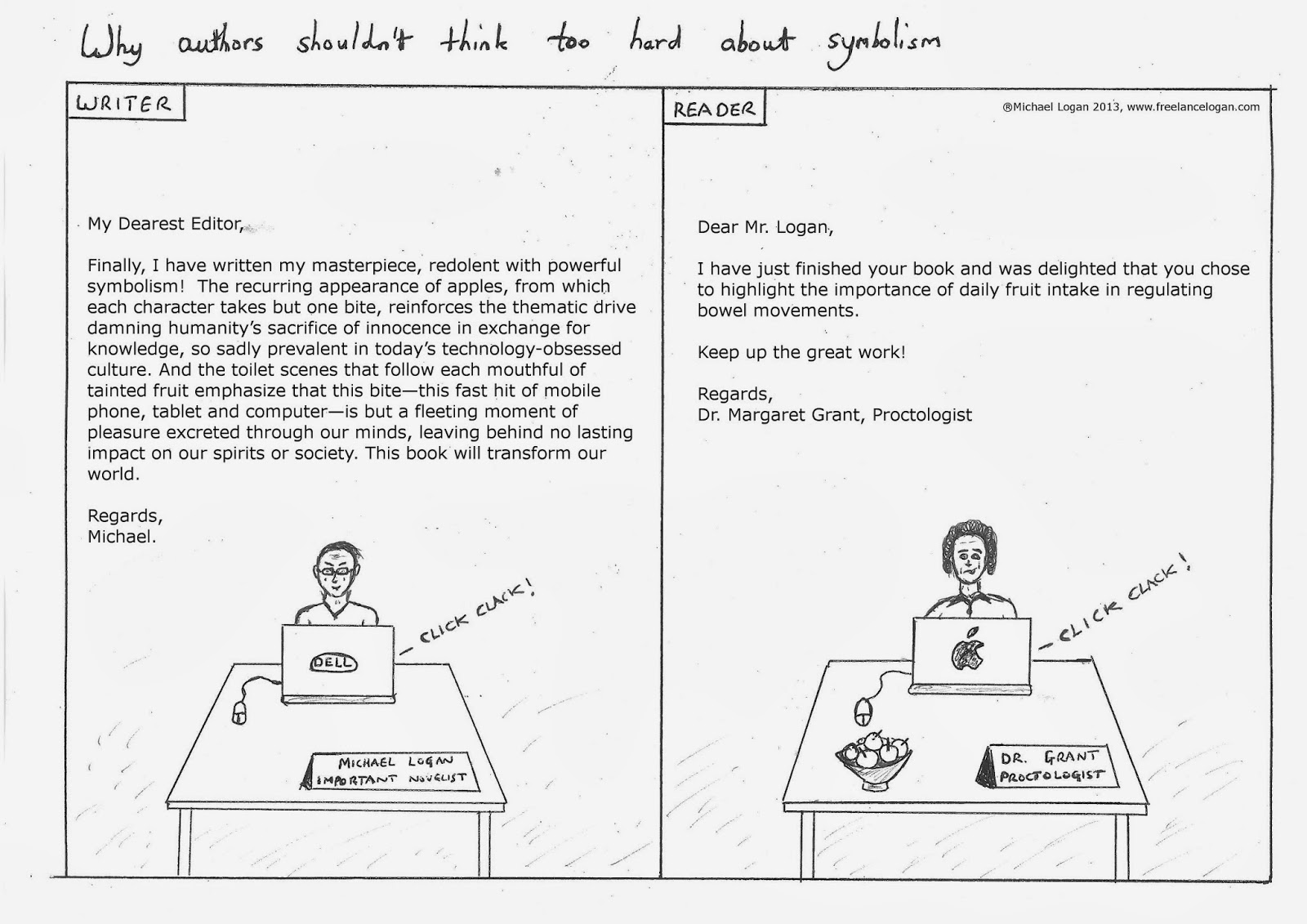
Why Authors Shouldn’t Think Too Hard About Symbolism

December 18, 2013 by Michael Logan


I love this story about a young student who wrote to authors asking them about their use of symbolism in their work.
What I find more often than not is that when I finish a piece of work and give it a last read, I discover many happy accidents of symbolism—which means my subconscious has been churning away and doing the work for me. Not that it particularly matters, in my view, as what I write and what somebody reads are two completely different entities.

Ray Bradbury told the student that each story is a Rorschach test, and I couldn’t agree more. People who read my work either credit me with too much intelligence or insight (something those who know me personally never do), or discredit me with far too much cynicism and downright nastiness. Always, though, these statements are made is if they are fact, which says a lot about the way every one of us is locked into our own subjective narrative of “truth”. 

Every reader (myself included) comes with their own set of experiences, assumptions and prejudices, and I believe we often approach a book with a pre-defined theory of what it is going to be about. And so, we then look for evidence to prove our theory: inflating the importance of passages or imagery that back it and conveniently ignoring those that do not. When that theory can’t be proven, it often seems to prompt a strong visceral reaction: ‘Because this book wasn’t what I thought it was going to be, it is a terrible book.’ Or even worse, your symbolism is misinterpreted, as is the case with our fictional proctologist above who can only see a treatise on bowel-cancer prevention (which is a worthy goal folks, and something more authors should base thrilling plots upon) in my astounding work of literary genius.
As a reader, I try to come to a book with as few preconceived ideas about it as possible, particularly since publishers’ marketing pitches can be off kilter and lead me to expect one thing when in fact I am going to get another. With this strategy, I can judge a book for what it is, rather than for what it isn’t. But that’s just me, and even then I can completely misread a book.
Anyway, this all just goes to show that you can’t write a book with a certain set of readers in mind, because they are all individuals. Write for yourself and for the story, and let the readers make of it what they will.

Filed Under: fiction, symbolism, writing

Violence and Graphic Imagery in Journalism and Fiction

July 25, 2012 by Michael Logan

I have had cause over the last year to think long and hard about the graphic depiction of violence and death, be it through images or words, in journalism and fiction. One reason for this is that my novel, Apocalypse Cow, has attracted comments for its violent scenes, some of which contain detailed descriptions. The other, and more significant, reason is that my journalism career has brought me into contact with many images of death.
When I was in my early 20s, I had a huge argument with a guy who was selling copies of Socialist Worker at Glasgow University over the issue he was waving around. The magazine cover carried the now-famous picture of the severed heads of three Serbs, with the boot of a Bosnian commander balanced atop one as it if were a football. I was outraged, in that way bolshie young students who think they know everything excel at, and accused him of using the image to sell more copies. His counter-argument, shouted at equal volume, ran that only through depicting the full horrors of war would people truly understand what we do to each other in the name or religion, politics and land.
Now, I believe I was wrong to get all aquiver.
Last year, when I was editing a website focusing on Somalia, virtually every day I received intensely graphic pictures of the conflict, usually without any warning in the subject line of the email. When I opened up the message, I would be confronted by huge, full-colour photographs of beheaded bodies, suicide bombers with their coiled and glistening entrails exposed and body parts scattered all around, and corpses displaying ragged entry and exit wounds. Every picture prompted a visceral reaction, and while I published only a select few, I always considered carefully whether I should share this feeling with the reading public.
There are several arguments for and against, and I feel the exploitation angle is the least convincing. Nobody likes to see such images, or at least nobody admits to liking it, and it usually causes a storm when such graphic violence is depicted. Why? After all, just because you don’t see it doesn’t mean it’s not happening.
I believe that without such images, it is far too easy for people to turn their backs on the reality of a conflict, whether their government is involved or not. How many times have you read an article about dozens being killed in a suicide bombing in Mogadishu or civilians being shot in the crossfire in Afghanistan, yet kept on eating your bacon sandwich, perhaps shaking your head a little. It doesn’t touch you. You just don’t feel it.
As someone who has spent the last ten years making his living from the written word, this is going to sound like heresy, but often only a picture can prompt that gut reaction.  I believe the media should show more images from war zones, to serve as a salutary lesson of what people are actually doing to each other, often in our names, outside the safe confines of our apartment walls.
The Kenya Burning exhibition and book, which depicted the full scale of the bloody tribal-tinged violence that swept the country after disputed elections in December 2007, is a perfect example of how images of death and destruction can create a positive effect. While Kenya’s population is just under 40 million, only around 1,500 people died, so most didn’t witness the violence first hand. This exhibition gave them a chance to really feel it, and played a key role in creating the ‘never again’ attitude that is now prevalent among many Kenyans – most of whom didn’t understand the full consequences of their role in stoking the conflict until confronted with these disturbing pictures.
However, there is another side to the story: the narrative that relatives of those who had died would be traumatized by what they see. I understand this argument, and can see why opening a newspaper or website to see the body of a loved one would prompt gut-wrenching anguish. This is why it was a tough one to call when working on the website, and I erred on the side of caution. Also, in an accident or natural disaster, there is little point to showing the pictures. When the Kenyan minister George Saitoti’s helicopter came down recently, Kenyan media ran graphic pictures of burned bodies, but this served no purpose, as those pictures would never stop another mechanical failure.
Much the same argument applies in fiction. My book is violent, something that has freaked out some readers – who have no problem reading about death as long as they aren’t presented with the details. I find this censorious attitude odd. Writers go into exhaustive detail on every other aspect of human existence, and this is not only embraced, but expected. Yet when it comes to death, it only seems acceptable to describe the emotional impact rather than the physical process.
My theory is that people rationalize their distaste for images or graphic descriptions of violence. They will call it exploitative, or gratuitous or plain tasteless. Ultimately, however, it is about our fear of death. We don’t like to be reminded of how fragile we are; how, in the end we are made up of flesh, bone, tissue and blood. It is hard to reconcile our rich inner lives, our concepts of self and soul, with the precarious biology of our bodies, which can be unravelled at any moment. Most of us can’t even bear seeing others in the nude, as evidenced by the repeated arrest of the naked rambler in Scotland, never mind digging deeper into the bodies that are so indistinguishable from one another and thus realizing we are perhaps not quite as individual or special as we thought.
Personally, I find it more distasteful when books and films are full of death, yet it is glossed over, the impact of the most profound thing that can happen to a human diluted by the audience being allowed to look away at the crucial moment. Glamorization of violence can only happen when the reader or viewer is allowed to enjoy the crash-bang-wallop action without being shown the full horror of violence. Death, particularly violent death, is bloody, horrific, disgusting and cruel. I believe it should be portrayed as such, otherwise we are shirking our responsibility to depict human existence as it is and allowing people to revel in the ‘glorious’ aspects of war or combat in any form.
Yes, depictions of graphic violence are disturbing, and so they should be. Aside from reminding us of our mortality, our uncomfortable reactions remind us of the basic human decency that prevents most of us from killing. That, in itself, is surely a worthwhile goal.

Filed Under: apocalypse cow, death, fiction, graphic images, journalism, media, violence

  • « Previous Page
  • 1
  • 2
  • 3
  • Next Page »

Recent Posts

  • Hell’s Detective 99 cents on Kindle
  • Who killed Jimi Hendrix?
  • Should we rethink the use of the term ‘white privilege’?
  • Online launch of Hell’s Detective
  • Altered Ego – another new short story
Follow Michael [feather_follow]

Copyright © 2026 · Author Pro Theme on Genesis Framework · WordPress · Log in